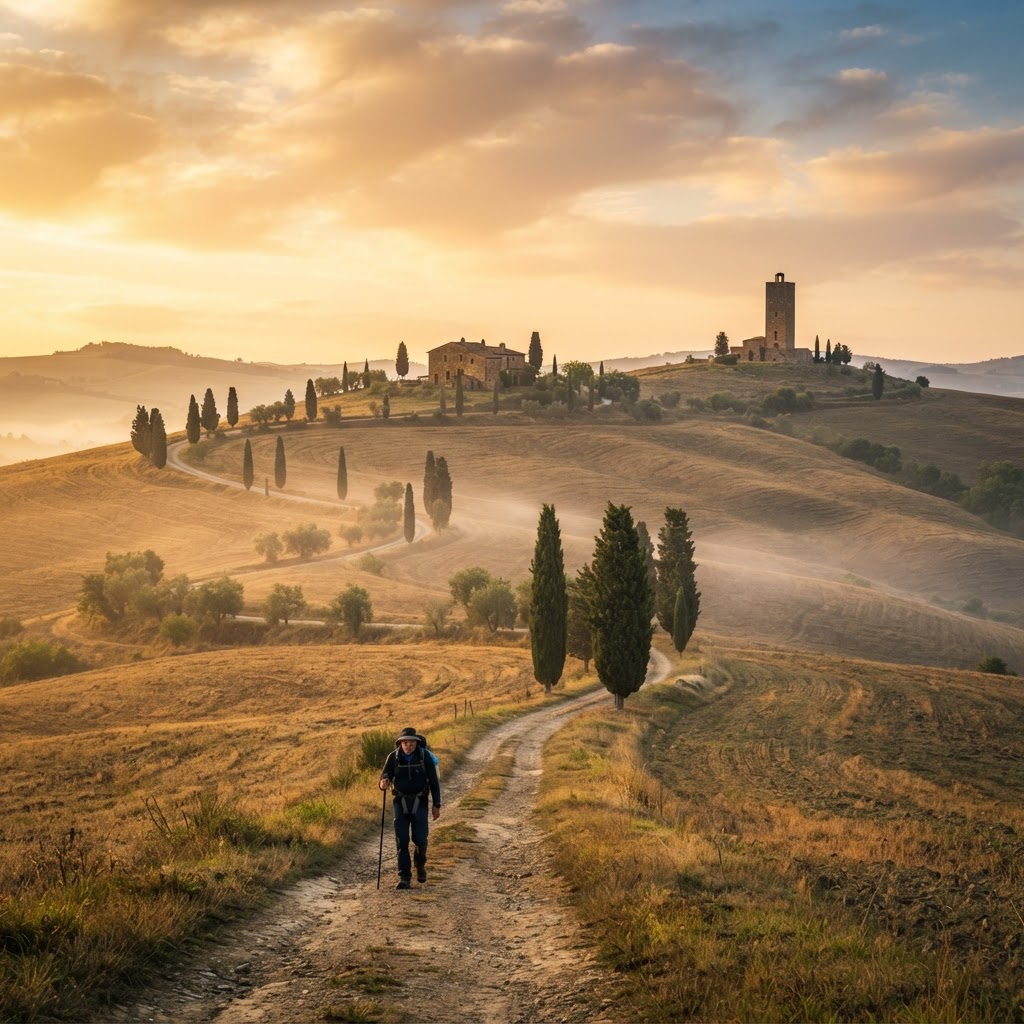
The Via Francigena is the great "other" pilgrimage of Europe — roughly 2,000 km from Canterbury in England through France and Switzerland to Rome. Walked by Archbishop Sigeric of Canterbury around 990 AD and declared a European Cultural Route by the Council of Europe, it is the Rome counterpart to the Camino de Santiago.
At a glance
- Distance: ~2,000 km (Canterbury → Rome); most walkers do a section
- Countries: England, France, Switzerland, Italy
- Difficulty: Moderate — flat start, big Alpine crossing (Grand St-Bernard), rolling Tuscan hills
- Crowds: Quiet — a fraction of the Camino's traffic
- Best months: May–June, September–October
- Credential: Testimonium (issued in Rome on completion)
The route
From Canterbury the route crosses the North Downs to the Channel, then runs through the Champagne and vineyards of Reims, the lakes of Lausanne, over the Grand St-Bernard Pass, down into the Aosta Valley. The Italian half is the most-loved part — through Vercelli and the Po plains, the walled abbeys of the Via di Bracciano (the traffic-free approach to Rome beloved of walkers), Siena, San Gimignano and the crete senesi of Tuscany, finishing at St Peter's Basilica in Rome.
Who is the Via Francigena for?
Walkers who loved the Camino's rhythm but want quieter paths, deeper history and Italian food. It demands a little more self-sufficiency: signage is good but accommodation is more scattered than on the Camino, and a typical day is 25 km between official stage towns.
Planning it
The route has 79 historic stages and the planning challenge is very Camino-like: daily pacing, finding beds, timing the Alpine crossing. Our sister site FrancigenaPlans.com is a dedicated interactive planner for the Via Francigena — stage maps, distances, lodging and day-by-day itineraries, the same way CaminoPlans plans the Camino.
FAQ
How long does the whole Via Francigena take?
About 3 months (~90 days) at an average of 22–25 km per day. Most walkers complete it in yearly sections or walk the classic final 2–3 weeks through Lazio and Tuscany.
Do I need a credential?
Yes — carry a Via Francigena credential ( disponibile from the EAVF or FrancigenaPlans.com) to collect stamps; it earns you the Testimonium in Rome and access to pilgrim accommodation.
Which section is best for a first taste?
The Tuscan stretch San Gimignano → Siena → Rome is the classic 10–14 day introduction.
Is it like the Camino?
Same spirit, quieter paths: fewer pilgrims, more trip planning. A dedicated planner like FrancigenaPlans.com closes that gap.
Plan your pilgrimage
The Via Francigena rewards planners. Start at FrancigenaPlans.com, or explore all Camino routes for your next walk to Santiago.
Explore all Camino routes
Camino de Santiago
Plan your Camino
The Via Francigena is Europe's Rome pilgrimage — ~2,000 km from Canterbury through France, Switzerland and Italy. Stages, the Testimonium, planning, and how it compares to the Camino de Santiago.