Search "Camino de Santiago tour" and you'll find dozens of agencies selling week-long packages for €1,200–1,800 — hotels pre-booked, luggage transferred, guide optional. Search "self-guided Camino" and you'll mostly find… the same agencies, using the word loosely. So let's be precise about what self-guided actually means, what it costs, and when a tour genuinely makes sense.
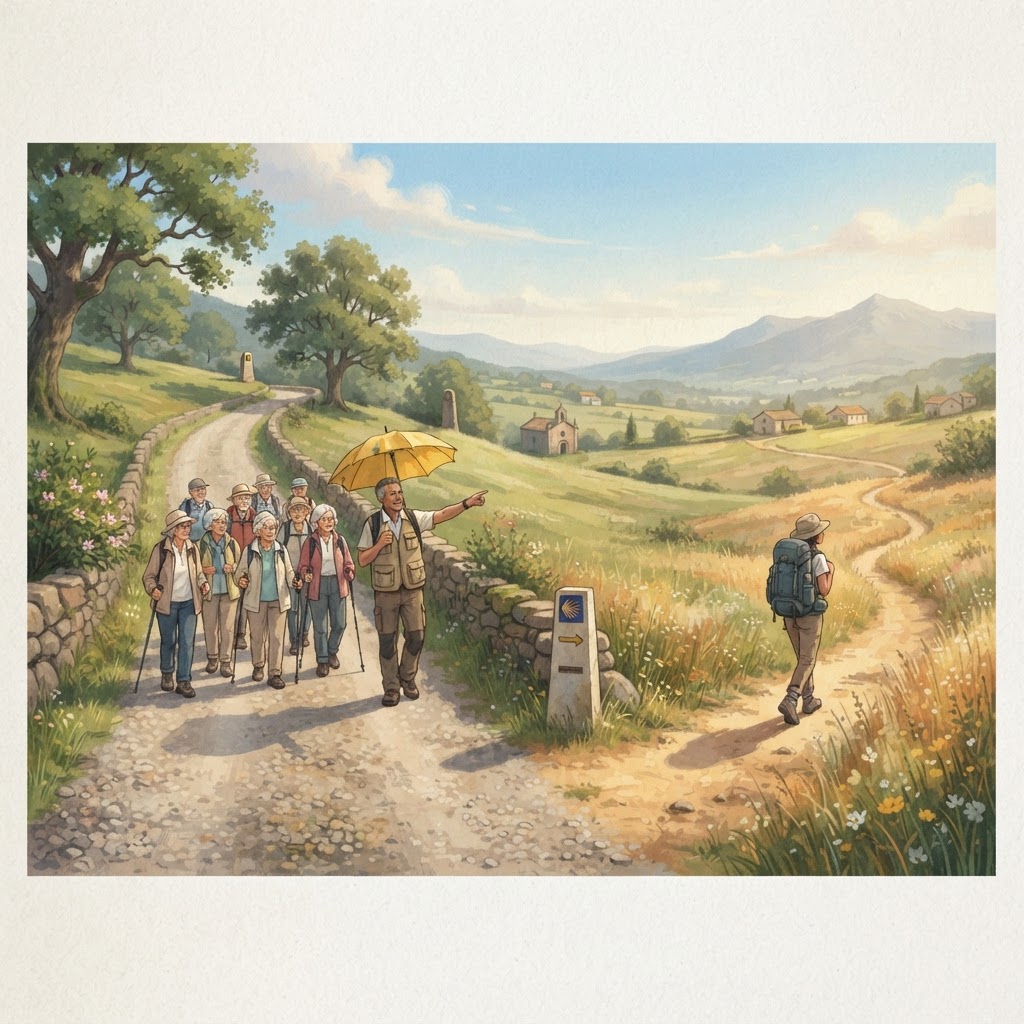
What "self-guided" actually means
Self-guided does not mean alone and it does not mean disorganized. It means you make the decisions:
- You pick the start point, the end point, and the daily distance.
- You book your own beds (or don't — albergues take walk-ins).
- You navigate with yellow arrows and your phone, not a tour leader.
- You walk with whoever you happen to meet, which changes daily.
What you lose: the guarantee of a private room every night and someone else solving problems. What you gain: the actual Camino — the one where pilgrims meet each other, plans change, and the trip costs a fifth of the price.
The honest comparison
| | Self-guided | Organized tour | |---|---|---| | Cost (last 100 km, 6 days) | €150–300 | €800–1,500 | | Cost (Porto–Santiago, 11 days) | €300–500 | €1,200–1,800 | | Luggage transfer | Optional, €3–7/stage | Included | | Pace | Yours | The group's | | Start point | Any town | Fixed | | Meeting people | Constant | Mostly your group | | Problem-solving | You (with tools) | The guide |
For context on that first row: a municipal albergue bunk is €8–14, a pilgrim menu dinner €10–12. The full math is in our budget guide.
What you actually need instead of an agency
Everything a package tour bundles, you can assemble free in an evening:
- The itinerary. The free CaminoPlans planner generates day-by-day stages with distances, elevation profiles, difficulty ratings and arrival dates for any start point on 11 routes. This is the part agencies charge most for, and it takes two minutes.
- Navigation. Every major route is marked with yellow arrows and scallop shells the entire way. The Walk Companion live mode shows your position on the route in real time, so "am I lost?" stops being a question.
- Accommodation. Each town page lists albergues and hotels with a "check availability" button that opens Booking.com with your dates pre-filled. Book the night before in high season; walk in during the rest of the year.
- The credential. A pilgrim passport costs €2–10 at your starting albergue or pilgrimage association. Two stamps a day for the Compostela.
When a tour genuinely makes sense
Credit where due — an organized tour is the right call if:
- You're walking alone and want zero logistics — someone meeting you at airports, bags waiting at hotels.
- You have mobility constraints and need guaranteed private rooms and short vehicle-assisted days.
- You want a curated group experience — some people travel to make friends by schedule, not by chance.
- You have exactly one week and refuse to make a single decision — fine, that's a product.
But notice that none of these are "the Camino requires a guide." It doesn't. The route is the most waymarked long-distance trail in Europe, and a 19-year-old with a phone navigates it exactly like a 70-year-old with a guide does.
The hybrid: self-guided with luggage transfer
If you want middle ground: walk self-guided but pay a local company ~€5/day to move your bag town to town. You get light shoulders and full freedom — most young pilgrims who "can't carry 7 kg" solve it this way, not with a package.
Verdict
If your Camino budget is under €600, self-guided isn't a compromise — it's the only version that fits, and it happens to be the more authentic one. Start with any route, any date: build your free itinerary. Still weighing it up? The full guide to walking the Camino self-guided covers costs, bookings and solo safety.
Explore all Camino routes
Camino de Santiago
Plan your Camino
A €300 self-guided Camino or a €1,500 package? Compare costs, flexibility, luggage transfer, navigation and who each option really suits — plus when a tour makes sense.